· Energy · Climate · Aruba
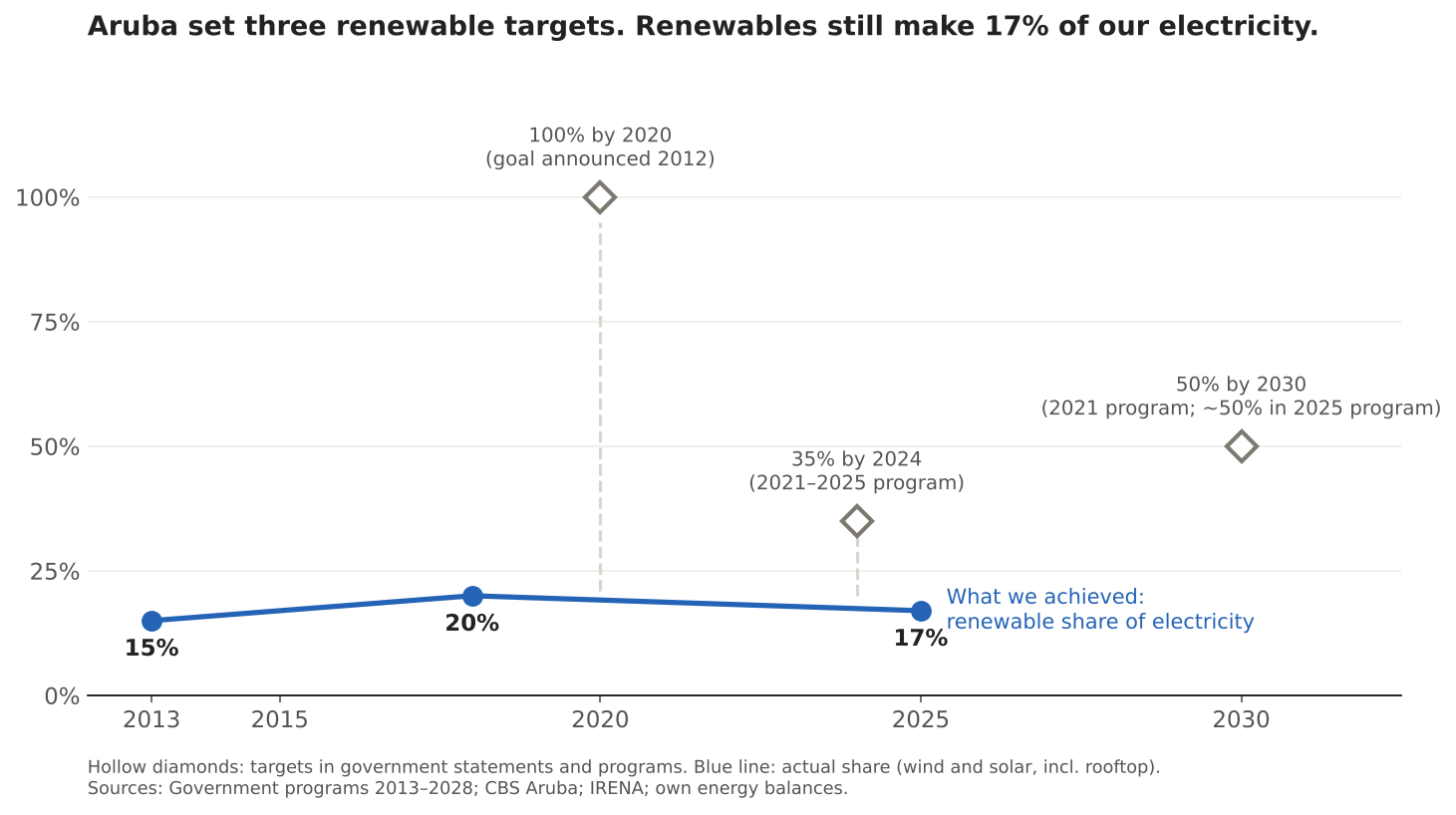
Aruba aimed for 100% renewable power by 2020 and reached 17%
As COP31 wraps up, I compared fourteen years of energy targets on my island with what we actually built, and why I still think the gap can close.
In 2012 the Government of Aruba announced that the island would run on 100% renewable energy by 2020. In April 2016 our Prime Minister signed the Paris Agreement at the United Nations on behalf of the Kingdom of the Netherlands. That same year I defended my MSc thesis at TU Delft on what that road would look like. Last year, wind and solar produced just 17% of our electricity.
For readers who don’t know Aruba: we are a Caribbean island of about 110,000 people and 180 km² (69 square miles), just off the coast of Venezuela, and part of the Kingdom of the Netherlands. Tourism drives our economy and pays our bills. Like most small islands, we make nearly all our electricity by burning imported oil.
This week governments are wrapping up COP31, the UN climate conference in Antalya, Türkiye, which ends on November 20. Small island states are again among the loudest voices in the room. James Fletcher, the climate envoy of the Caribbean Community, put it simply: the region is paying twice, first in hurricane and drought damage from a crisis we did little to cause, and then in the debt it takes on to rebuild. Each COP produces new targets and is a good moment to examine where we are. I wanted to see what happened to our own targets in Aruba so I went back through every government program since 2013 and compared what was promised with what I could measure.
The promises
Each new cabinet in Aruba publishes a government program, the regeerprogramma, based on the coalition agreement between the governing parties.
| Year | Source | Target |
|---|---|---|
| 2012 | Government announcement | 100% renewable energy by 2020 |
| 2013 | Government program 2013 to 2017 | No more fossil fuel by 2020, a second wind farm, LNG storage |
| 2017 | Government program 2017 to 2021 | More wind and solar, seawater cooling, no number or date |
| 2021 | Government program 2021 to 2025 | 35% wind and solar by 2024, 50% by 2030, 15% electric vehicles by 2030, LNG as the main power fuel |
| 2025 | Government program 2025 to 2028 | About 50% renewable electricity, no year (raised to 60% by the Prime Minister in May 2025) |
The 2021 program was the only one to put dates on its milestones. None of these programs came with a procurement plan or budgets attached to them.
What was built
Our electricity comes from WEB Aruba, the state-owned power and water company, and is delivered and sold by Elmar, the state-owned grid company. By far the largest renewable source is the 30 MW Vader Piet wind farm on the east coast. It started running in 2009, three years before the 100% pledge, and sells its power to WEB under a long-term contract with the private owner, NuCapital. In a typical year it still supplies around two thirds of our renewable electricity. After the pledge, the only utility-scale additions were solar parks, the largest being WEB’s 6 MW Sunrise park, finished in 2018. Since then, nearly all new renewable capacity has come from homes and businesses putting panels on their own roofs. The grid company informally estimates that at about 30 MW today, more than all the utility solar on the island.
The second wind farm, first promised in 2013, was abandoned after objections from neighbors. An LNG import terminal originally signed in 2021 under a 20 year lock-in agreement was canceled this year due to lack of progress and inability to secure permitting.
Looking back, that is not a big loss. When I ran the numbers, switching our engines from heavy fuel oil to natural gas would have changed electricity tariffs somewhere between 7% lower and 3% higher, depending on gas prices, and cut emissions by only about 2% once you count the methane that leaks along the supply chain and slips unburned through the engines. That’s a long contract and a lot of new infrastructure for very little change.
The island changed more than the plans expected
When I looked at population and economic data next to the energy numbers, the picture makes more sense.
| 2013 | 2025 | Change | |
|---|---|---|---|
| Residents | 105,700 | 109,500 | +4% |
| Overnight visitors | 979,000 | 1,515,000 | +55% |
| Real GDP, 2013 prices | US$2.7 billion | US$3.7 billion | +36% |
| Electricity generated | 928 GWh | 1,143 GWh | +23% |
| Renewable electricity | 136 GWh | 199 GWh | +46% |
| Renewable share | 15% | 17% | +2 points |
| CO₂ per kWh generated | 675 g | 535 g | −21% |
| Total CO₂ emissions | 880,000 t | 954,000 t | +8% |
| CO₂ per resident | 8.3 t | 8.7 t | +5% |
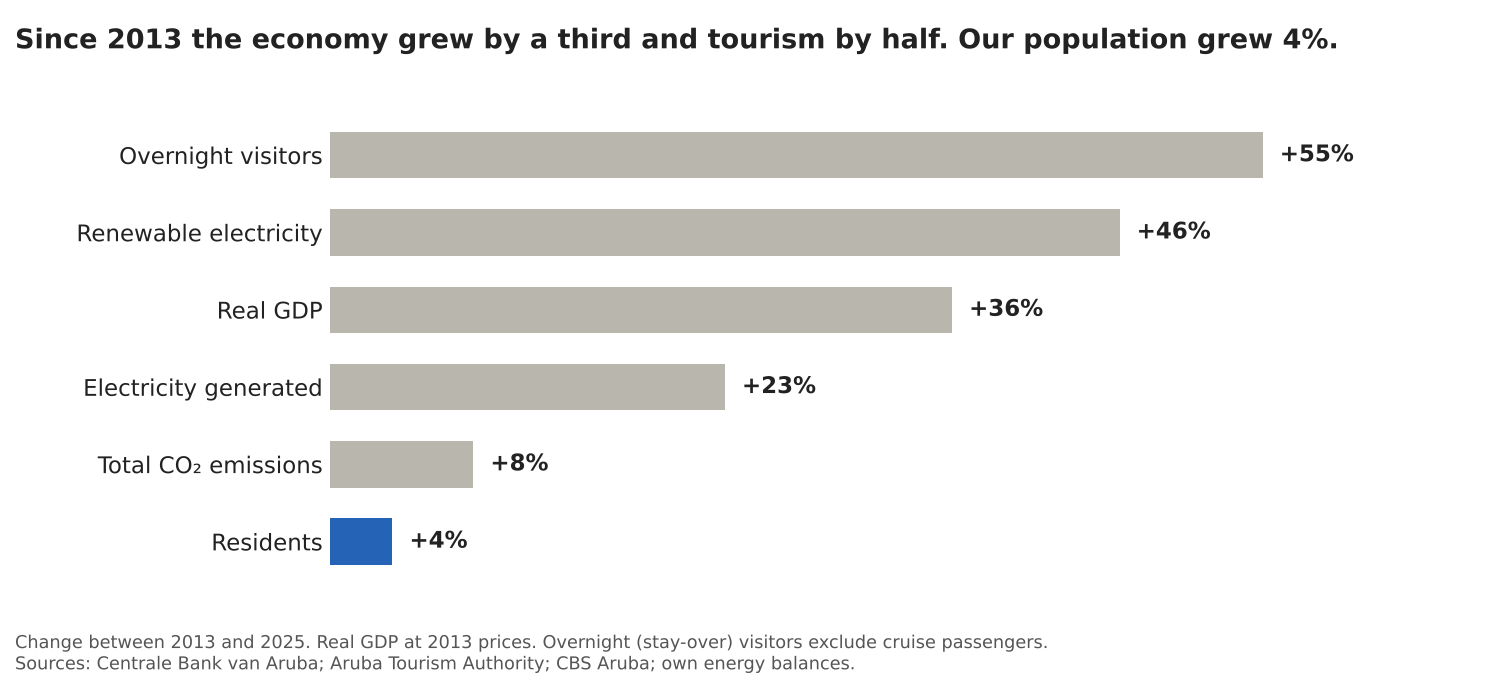
The number of people living in Aruba barely moved in twelve years. The economy grew by more than a third along with tourism. In 2025 we received about 1.5 million overnight visitors and close to a million cruise passengers according to figures from our central bank. Hotels, Airbnbs, restaurants and the rental cars that serve our tourists pushed electricity demand up by almost a quarter.
Renewable electricity grew faster than the economy, 46%. But it started from a very small base, and total demand grew by about 215 GWh a year while renewables added about 63 GWh. So the share stayed almost flat.
Seen this way, the record is less bleak. For every dollar of economic output, Aruba now emits about a fifth less CO₂ than in 2013. Per resident, emissions rose about 5%, and a good part of them really belong to the visitors we host.
Where the emissions went
The power sector got cleaner without that much effort. In 2022 WEB replaced its old steam boilers with modern engines, mainly for cost and flexibility. Each kWh from our grid now carries 21% less CO₂. By my estimate that single investment avoided about six times more CO₂ than all the renewables added since 2013.
Transport went the other way.
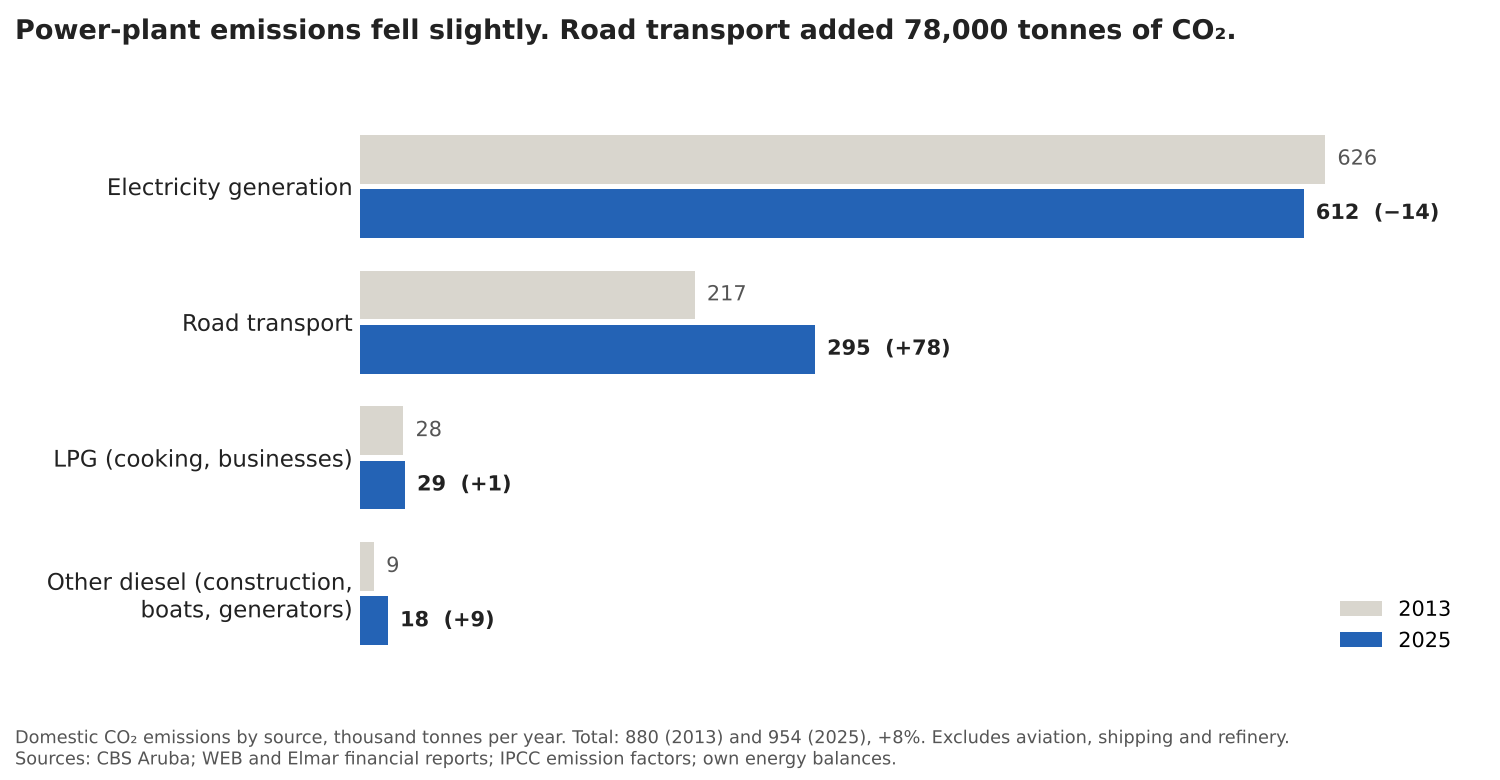
Road transport emissions rose 36%, adding 78,000 tonnes of CO₂ a year, more than five times what the power plant saved.
The number of vehicles explains most of it. At the end of 2015, Aruba’s tax office had about 67,000 vehicles registered. In January 2026 it counted 97,710, and it expects to pass 100,000 this year. By 2024 we had 737 passenger cars for every 1,000 residents, and the rental car fleet had grown by half since 2015, from about 3,700 to 5,500 cars. Unfortunately, little to no noticeable investments have been made in modernizing the public transportation sector.
Aruba doesn’t publish how many cars are electric. Using what exporting countries report to the UN Comtrade database, we can estimate about 1,350 battery-electric cars shipped between 2021 and 2025, most of them from China. That is about 1.4% of the vehicles on the road. The 2021 program had set a target of 15% electric vehicles by 2030, we are far from it.
So we missed every renewable target but the electric grid got cleaner anyway. Nonetheless, the total emissions still rose because of cars.
Why I’m optimistic
Every Aruban government since 2012 has wanted more renewable energy, and I believe the targets were sincere. What has been missing is a step between a target and a tender: fixed dates along with a procurement plan, and an independent regulator that publishes how prices are set and real incentives to keep the instruments needed to finance these projects in the island.
The economics have turned in our favor. A home solar system in Aruba was quoted at about US$2.42 per watt in both 2012 and 2016. This year, commercial systems are being quoted at US$1.22 to US$1.34 per watt, roughly half. Battery modules are now quoted locally at around US$210 per kWh, close to European prices and they are expected to keep coming down.
The money is there too. Our central bank reports that the government closed 2025 with a budget surplus of Afl 245 million (about US$137 million) and there’s talk about excess liquidity in the private sector. Our neighbor Bonaire, also an island in the Dutch Kingdom, shows what good rules could look like: since 2016 an independent Dutch regulator has set its power tariffs, publishes the full cost behind them, and since this year rewards producers that beat their renewable targets.
Electric cars are finally starting to take hold. The trade data shows that about 45 EVs were shipped to Aruba in 2021 and close to 500 in 2025, mostly after the first official dealer for a Chinese brand opened.
The utility is moving too. In October WEB signed with Wärtsilä for a 35 MW, 70 MWh battery, the largest in the Caribbean, due in 2028 and part of WEB’s goal of producing half its electricity from renewables by 2030. Its technical director has said the next step is a second wind park and new turbines at Vader Piet, whose owner expects the current ones to need replacing by 2030.
Residents are already ahead of the plans. 30 MW on our roofs went up without a single government tender even with restrictions and grid connection fees, because it made sense on the electricity bill.
Where I think we should go from here
- Open the books. Publish every year, next to the renewable share, the CO₂ per kWh, total emissions, transport fuel use and the costs behind the tariff. The statistics office and the utilities already have the data.
- Give the sector a referee. An independent regulator should set tariffs and publish how it does it. The Aruba Fair Trade Authority is already studying the idea, and Bonaire’s model is ready to be adapted.
- Let customers help run the grid. Thirty megawatts of rooftop solar went up without a tender, and the home and business batteries now being sold here show that people want to do more. WEB’s new battery is welcome, but storage shouldn’t stop at the utility’s fence. Pay customers whose batteries charge at midday and discharge in the evening, and those who shift air conditioning, water heating or car charging when the grid needs it.
- Bring cars into the plan. Ethiopia, short of foreign currency to pay for fuel, banned imports of petrol and diesel cars in 2024. Aruba doesn’t need to go that far, but publishing electric vehicle registrations, setting import duties by CO₂ and offering a cheaper daytime charging rate would be a good start. Rental fleets, which are replaced every few years, are the obvious place to begin.
- Tender the big projects. Put new solar parks, the second wind farm and the Vader Piet repowering out to competitive bids, with contracts that are not linked to the oil price.
- Cool the hotels with the sea. By my estimate our hotels alone use about a tenth of the island’s electricity for air conditioning, around 115 GWh a year, and most of them sit along one stretch of coast. Seawater air conditioning, SWAC, pumps cold water from about 900 m deep and replaces most of the electricity used by chillers, with estimated savings of 80 to 90%. If half of the hotel cooling load switched, we would save roughly 50 GWh a year, about 4% of our electricity and 25,000 to 30,000 tonnes of CO₂, mostly in the evening and at night when solar can’t help. The 2017 government program promised seawater cooling, but no study has been commissioned.
- Make room for new ideas. Set aside sites, grid connections and small power contracts for technologies that are not yet commercial, such as ocean thermal (OTEC) or wave energy. Islands are where these technologies can flourish and make real impacts.
None of these things have to happen in order and can move at the same time, each one making the others easier.
COP31 will close on Friday with another round of commitments. Aruba doesn’t need a bigger promise. We need the next five years to be the first in which we build what we promised, and with solar at half the price it was a decade ago, we should be able to do it while lowering electricity bills and keeping more of the tourism income inside of our own economy and not letting it leave to pay for expensive oil.